
⚡ Key Engineering Takeaways (Quick Summary)
- Roll compaction parameters: knurled, fluted, and smooth roll profiles for high-density dry slugging.
- Co-mill impeller profile geometry and screen apertures for tight granule size distribution (PSD).
- Containment solutions: split butterfly valves and pneumatic vacuum transfer to eliminate operator exposure.
- Sanitary fabrication in SS 316L with Ra <= 0.4um electro-polished finish for fast CIP validation.
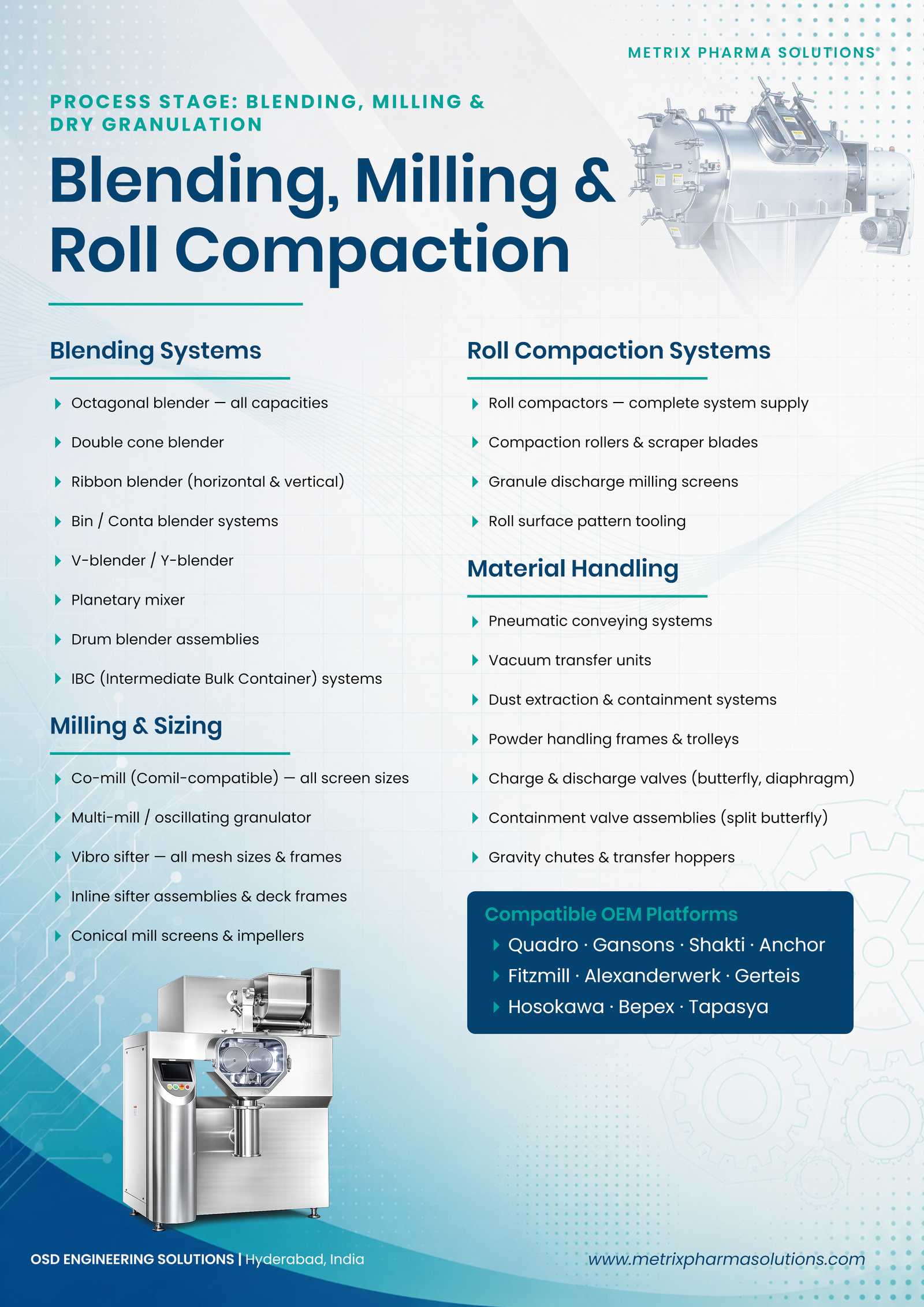
Compatible Global OEM Machinery Platforms
Metrix manufactures direct drop-in replacement components and rebuild kits compatible with:
1. Dry Granulation Roll Compaction: Working Principle & Roll Tooling
When formulations contain moisture-sensitive active pharmaceutical ingredients or thermolabile compounds that degrade during fluid bed drying, dry granulation via Roll Compactor is the industry standard. Roll compactors squeeze conditioned powder between counter-rotating rollers under hydraulic force (up to 20 kN/cm linear load) to form uniform ribbons or flakes (slugs).
Roll tooling profiles include:
- Smooth Rollers: Ideal for fine chemical powders and ductile materials requiring uniform linear compaction.
- Knurled / Diamond Rollers: Designed for fluffy or low-bulk-density formulations requiring positive mechanical traction without roller slippage.
- Fluted / Corrugated Rollers: Engineered for fibrous or high-elastic recovery materials where rapid de-aeration is critical.
2. Precision Milling & Particle Sizing (Co-Mill vs Multi-Mill)
Following dry compaction or wet drying, granules must be sized to achieve narrow particle size distributions (PSD). Conical screen mills (Co-mills) achieve this through low-shear centrifugal acceleration, delivering minimal dusting and zero API heat degradation compared to traditional high-speed hammer mills. Metrix supplies replacement screens (round hole, rasp/grater, square hole from 0.5 mm to 3.0 mm) compatible with Quadro Comil and Fitzmill platforms.
Explore Related OSD Engineering Guides:
Frequently Asked Technical Questions (AEO Q&A)
Q1: When is dry granulation roll compaction mandatory over wet granulation?
Dry granulation is required for moisture-sensitive (hygroscopic) active pharmaceutical ingredients, effervescent formulations, and heat-sensitive compounds where liquid binders and thermal drying cause active chemical degradation.
Q2: What is the advantage of conical co-mills over traditional hammer mills and multi-mills?
Co-mills utilize gentle vortex acceleration with lower tip speeds, preventing fine dusting and API heat buildup, yielding uniform narrow particle distributions with lower noise.
Q3: Can Metrix manufacture custom roll compactor rolls for Alexanderwerk and Gerteis machines?
Yes. Metrix manufactures high-hardness alloy steel and custom grooved/knurled roller surfaces with precision scraper blades, cryogenic hard-chrome treatments, and internal chilled water cooling channels.
Authored by Metrix Pharma Solutions Engineering Division
Based in Miyapur, Hyderabad, our team brings decades of cumulative experience in mechanical fabrication, precision punch tooling, fluid bed engineering, and validated pharmaceutical automation.
Verified for compliance with cGMP, US FDA 21 CFR Part 11, and ASME BPE guidelines.